Google AI Mode guide: what it is, what changed, and how to adapt SEO
Learn what Google AI Mode is, how it works, how it differs from AI Overviews, and what Google's official guidance means for SEO in 2026.
SEO leads, content strategists, and founders adapting to Google AI Mode and AI Overviews in 2026
Google AI Mode / AI Overviews
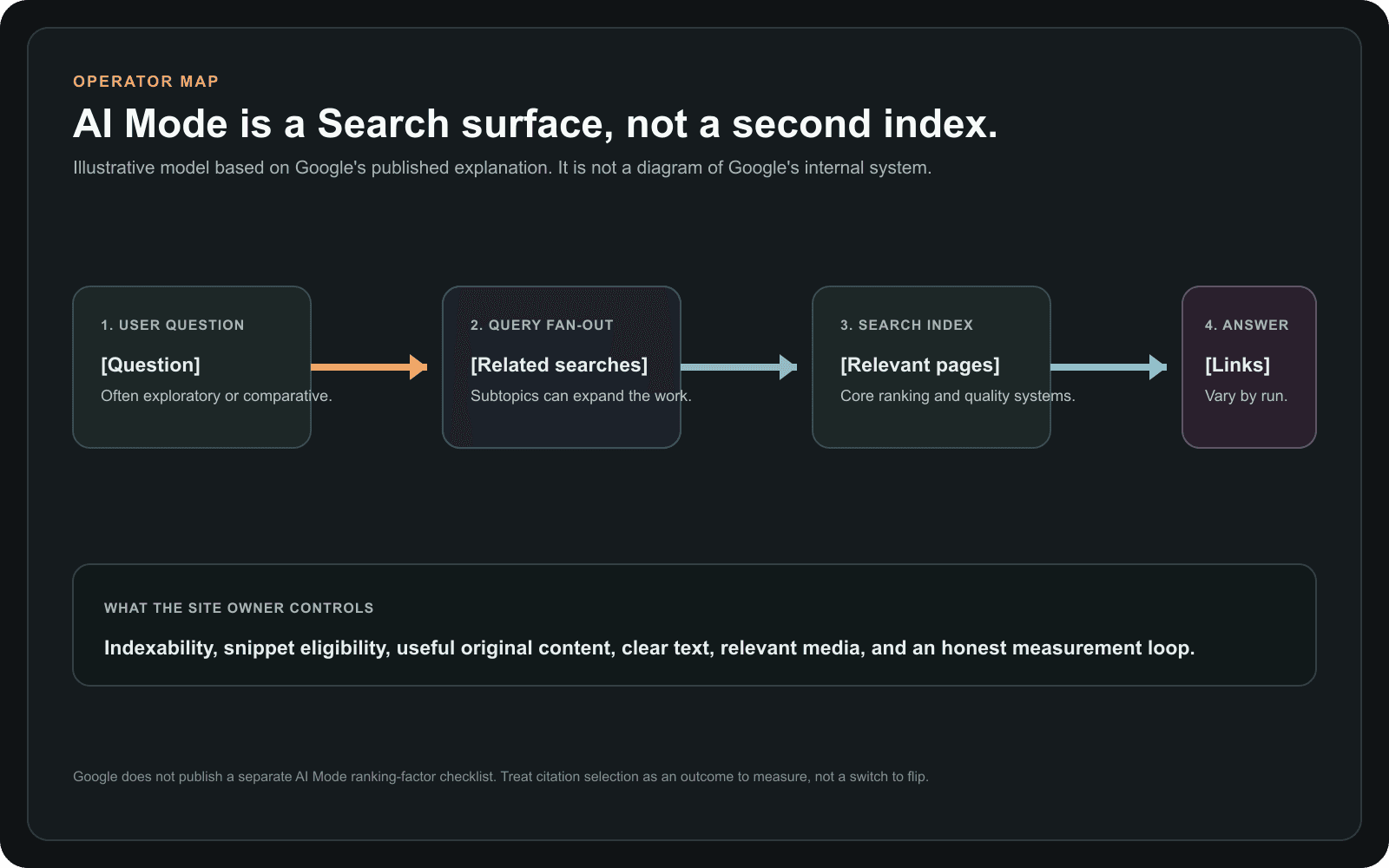
Google AI Mode is Google's conversational Search experience for questions that need exploration, reasoning, or a real comparison. It responds with an AI-generated answer and supporting links, but it is still grounded in Google's Search index and core Search systems.
That distinction matters. AI Mode changes where some research journeys happen, not the basic requirement that a page deserves to be found. Google is explicit that there is no AI-only checklist, special markup, or text file that turns a page into an AI Mode citation.
This guide answers the definition and how-it-works questions first, then shows the page changes worth making, the claims to ignore, and the measurement loop I would use now.
Best Next Step
Instrument AI Mode alongside classic SEO
AgentSEO helps teams compare Google answer-layer visibility with classic rankings, saved citations, and page-level next actions in one workflow-shaped output.
What Google AI Mode is in plain English
AI Mode is Google's chat-style answer layer for more exploratory or comparison-heavy search sessions.
AI Mode is a conversational interface inside Google Search. A user asks a question, often in a longer natural-language format, and Google returns a synthesized answer generated with Gemini plus links to supporting sites.
Google's own documentation says AI Mode is especially useful for questions that need further exploration, reasoning, or complex comparisons. In practice, that means more of the research journey can happen inside Google before a click happens. A supporting link can still matter, but it has to earn its place in a more demanding session.
What Google's latest guidance says
The important current takeaway is that Google frames AI Mode as part of Search, not as a separate optimization universe.
Google's AI features documentation says the same foundational SEO best practices still apply to AI Mode and AI Overviews. Pages must be indexed and eligible to appear in Search with a snippet, and there are no additional technical requirements just for AI Mode.
Google's generative AI optimization guide, announced May 15, 2026, adds more detail. It says these features use techniques like retrieval-augmented generation and query fan-out, and it explicitly advises site owners to focus on non-commodity content, clear technical structure, and people-first usefulness instead of AI-specific gimmicks.
Related reading
| Official point | What it means | What to do |
|---|---|---|
| No additional technical requirements | AI Mode eligibility starts with normal Search eligibility | Keep pages indexable, crawlable, and snippet-eligible |
| SEO is still relevant | Core ranking and quality systems still feed the answer layer | Keep improving the pages that already deserve to rank |
| Query fan-out is part of the system | Your page may be evaluated alongside related subtopic queries | Cover adjacent questions, comparisons, and supporting evidence clearly |
| Non-commodity content matters | Generic summaries are easier to replace | Add first-hand proof, sharper interpretation, and specific examples |
| Ignore AI-only hacks | llms.txt, fake mentions, and mechanical rewrites are not the win condition | Keep FAQ schema honest and aligned to visible content, but do not expect it to carry the page |
AI Mode vs AI Overviews vs classic search
The three surfaces share infrastructure, but they trigger differently and create different content demands.
Users still experience one Google product, but the retrieval and presentation shape changes by surface. That matters for page strategy because some assets are better at earning classic clicks, while others are better at feeding answer extraction and follow-up exploration.
| Surface | Typical trigger | What it rewards most |
|---|---|---|
| Classic search | Default web query behavior | Ranking strength, relevance, and click-oriented snippets |
| AI Overview | Many informational, ambiguous, or comparison queries | Extractable answers and support links above the standard results |
| AI Mode | Chat-style, exploratory, or reasoning-heavy questions | Clear definitions, comparisons, evidence, and pages that support follow-up questions |
What changed for SEO teams in 2026
The distribution mix changed even though the technical foundation stayed familiar.
The biggest change is not that SEO stopped mattering. It is that more discovery now happens before the click. Informational queries are more likely to be partially satisfied inside AI Overviews or AI Mode, which means brand exposure and source selection matter more than they used to.
The measurement layer also improved. Google announced generative AI performance reports in Search Console on June 3, 2026, then completed worldwide rollout on August 31. The reports provide dedicated visibility views for generative AI features in Search and Discover. That is helpful, but it still does not replace a prompt-level review loop when you want to understand which pages were cited and why.
- More informational journeys now stay inside Google's answer layer longer.
- Brand mention quality matters more because many visits happen later, not immediately.
- AI inclusion is now part of the visibility story, not a side metric.
- Search Console now provides dedicated generative AI visibility reports worldwide.
- Teams need both classic SEO reporting and answer-layer measurement together.
How to adapt pages for AI Mode without rewriting the whole site
The highest-leverage edits usually happen at the top of the page and in the proof layer.
You usually do not need a full-site rewrite. You need sharper openings, clearer comparisons, stronger first-party proof, and page structures that make it easier for Google to extract the useful answer.
This is where page type matters. A doc page, a comparison page, and an educational guide should not all be optimized the same way even if they sit in the same topic cluster.
| Page type | What to improve first | Why it helps |
|---|---|---|
| Educational blog post | Direct answer intro plus section summaries | Makes the page easier to extract for informational and follow-up prompts. |
| Comparison page | Clear winner framing, tables, and decision criteria | Supports complex comparison queries that often trigger AI Mode. |
| Docs page | Plain-language setup steps and predictable structure | Helps Google retrieve implementation answers with fewer jumps. |
| Product or feature page | Category clarity, use cases, and proof | Helps brand pages support exploratory commercial queries. |
What affects AI Mode eligibility, usefulness, and trust
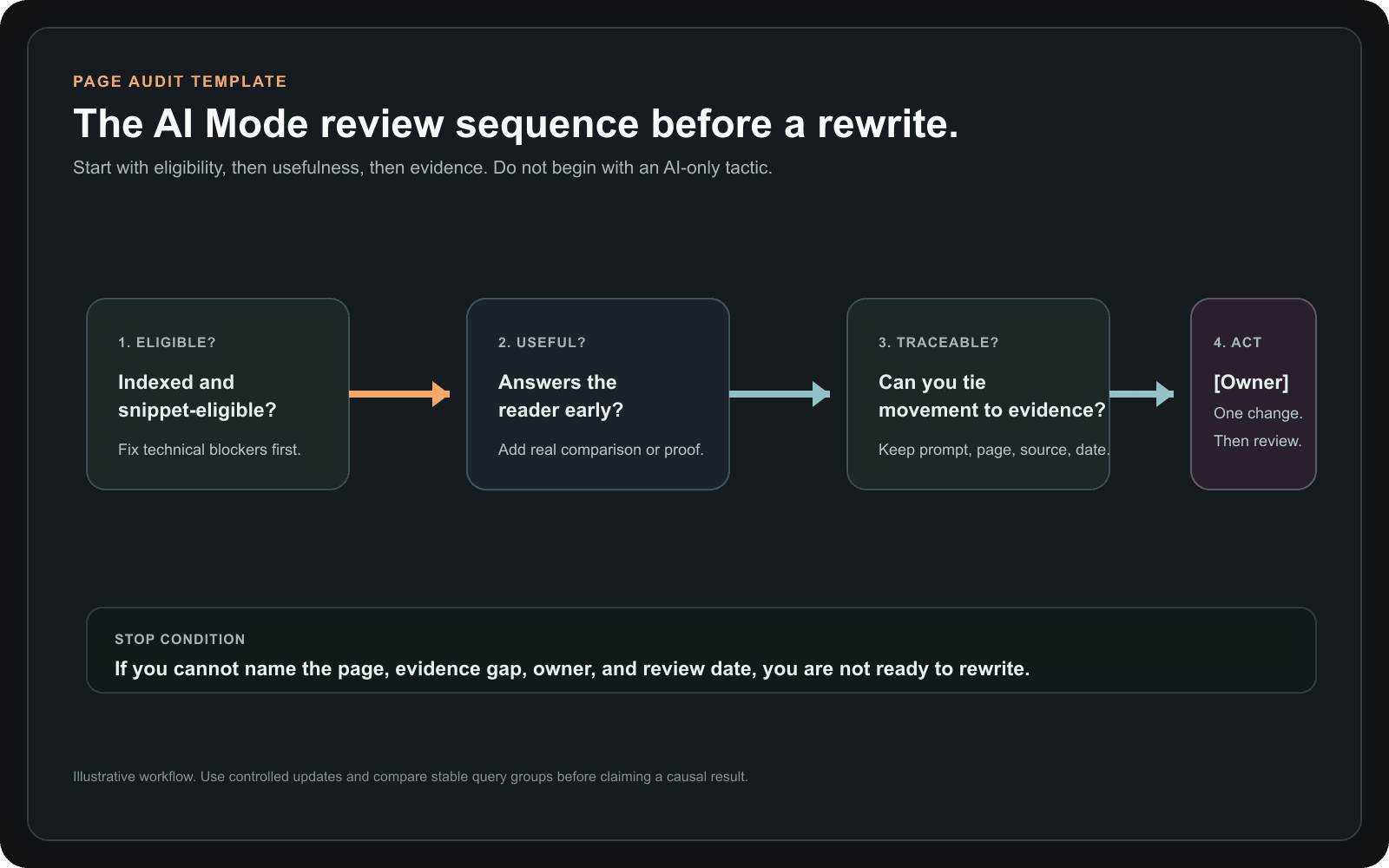
Google has not published a separate AI Mode ranking-factor list, so separate confirmed requirements from practical page improvements and unproven claims.
The phrase AI Mode ranking factors sounds more certain than the public evidence allows. Google confirms that a page must be indexed, eligible to appear in Search with a snippet, and compliant with normal Search policies. Beyond that boundary, direct answers, useful comparisons, first-hand evidence, and clear ownership are sensible page improvements because they help people and make the content easier to understand. They are not guaranteed citation switches.
Third-party discussion can be valuable when it reflects genuine experience: an independent review, a detailed forum answer, a customer walkthrough, or a video that demonstrates the product. Treat those sources as evidence and distribution, not as manufactured ranking signals. Google explicitly warns against inauthentic mentions and scaled content created to manipulate AI responses.
Related reading
- Render the main answer in crawlable HTML and keep the canonical URL clean.
- Make structured data match the visible page; do not expect a special AI-search boost.
- Add first-hand examples, screenshots, data, or demonstrations only when they prove the claim.
- Use Reddit, forums, social posts, and videos to discover real questions and earn authentic third-party context.
- Validate changes against stable query groups instead of declaring a universal factor from one citation.
| Evidence level | What belongs here | How to act |
|---|---|---|
| Confirmed by Google | Search index eligibility, snippet eligibility, crawlability, and compliance with Search policies | Fix technical access, canonicalization, and content-policy problems first |
| Practical page improvement | A direct answer, clear headings, comparisons, original examples, visible authorship, and accurate dates | Improve the page for the user, then measure Search and answer-layer movement |
| Independent trust evidence | Real reviews, community discussions, demonstrations, and third-party coverage | Earn these through a useful product and original participation; do not manufacture them |
| Unproven shortcut | Magic word counts, keyword density, cosmetic date changes, special AI files, or schema used as a citation switch | Do not prioritize without evidence from a controlled page-level test |
What not to do for Google AI Mode
Google's current documentation is unusually explicit about the myths you can ignore.
Google says you do not need special AI-only files such as llms.txt for Google Search, and it warns against inauthentic mentions and scaled content patterns aimed at manipulating responses. That matters because a lot of AI Mode advice online still sounds like a shortcut catalog.
This does not mean you should stop using structured data or stop thinking about answer formatting. It means the structure should support honest page clarity, not act as a substitute for quality.
- Do not publish near-duplicate AI pages to chase every fan-out query.
- Do not seek inauthentic mentions just to look more citable.
- Do not rely on FAQ schema alone to compensate for slow, vague copy.
- Do not treat AI Mode as a reason to abandon classic SEO and technical hygiene.
How to measure AI Mode visibility
Use Google's reporting where available, but keep a repeatable prompt and citation loop for working decisions.
Use Google's generative AI performance reports in Search Console. They help you see impressions, pages, countries, devices, and dates connected to generative AI features in Search and Discover.
For the working team, that still is not enough. You also need a fixed prompt set, weekly checks, a citation log, and a way to compare the answer layer with classic rankings and page edits.
Review one target page against these six checks:

1. Does the first paragraph answer the query in plain language?
2. Is the page already ranking or competing for related classic queries?
3. Are comparisons, definitions, or evidence visible high on the page?
4. Do published and updated dates match the actual revision?
5. Does FAQ schema match the visible questions and claims exactly?
6. If the click disappeared, would the brand mention still be useful?| Signal | How to collect it | Cadence |
|---|---|---|
| Generative AI impressions | Google Search Console generative AI report when available | Weekly |
| Prompt citations | Run a fixed prompt set and log sources and winners | Weekly |
| Brand mention rate | Count how often your brand appears on category and comparison prompts | Weekly |
| Page response to edits | Compare citation and mention shifts after changes | Weekly |
How AgentSEO turns AI Mode monitoring into a workflow
The useful output is not an AI Mode vanity score. It is a page-level decision with evidence.
A growth engineer can use AgentSEO to keep AI Mode monitoring close to classic SEO monitoring instead of creating a disconnected AI-search report. The same query group should track ranking, AI Overview presence, source inclusion, and the page that should be updated next.
That matters because Google says its AI features are rooted in core Search ranking and quality systems. The practical response is to improve the page that already deserves to rank, not to create a separate pile of AI-only pages.
Related reading
curl -s -X POST "https://www.agentseo.dev/api/v1/ai-overview/extract?sync=true" \
  -H "x-api-key: YOUR_AGENTSEO_API_KEY" \
  -H "content-type: application/json" \
  -d '{
    "keyword": "google ai mode seo",
    "location": "United States",
    "language": "en",
    "target_domain": "agentseo.dev"
}'| Signal | Why it matters | Next action |
|---|---|---|
| Classic rank is stable, AI inclusion is missing | The page may be relevant but not extractable enough | Rewrite the opening answer and add a comparison table |
| AI Overview cites a competitor, rank is below top ten | The problem may still be classic SEO strength | Improve the source page and internal links before AI-specific rewrites |
| Brand appears but URL is not cited | Entity awareness exists, source attribution is weak | Add stronger first-party proof and clearer page ownership |
The AI Mode mistakes I see most
These patterns create busy work without improving eligibility or extractability.
These mistakes look like work. They are. They just do not move the metric in a durable way.
- Adding schema without matching the visible page content.
- Rewriting titles for AI while leaving the intro paragraph slow and generic.
- Publishing commodity content that could have come from any site.
- Chasing every new query without a stable prompt set.
- Reporting classic SEO metrics alone and calling it AI Mode measurement.
Keep the workflow moving
Instrument AI Mode alongside classic SEO
AgentSEO helps teams compare Google answer-layer visibility with classic rankings, saved citations, and page-level next actions in one workflow-shaped output.

Daniel Martin
Cofounder, AgentSEO
Inc. 5000 Honoree and cofounder of AgentSEO and Joy Technologies. Daniel has helped 600+ B2B companies grow through search and now writes about practical SEO infrastructure for AI agents, MCP workflows, and REST-first execution systems.
FAQ
Questions teams usually ask next
What is Google AI Mode in one sentence?
Google AI Mode is Google's conversational Search experience for exploratory questions, reasoning, and comparisons; it produces an AI-generated answer with supporting links from Google's Search index.
How is AI Mode different from AI Overviews?
AI Overviews appear above classic results for informational queries. AI Mode is a separate chat tab the user opens for a conversational session.
Is Google AI Mode the same as Gemini?
No. Google AI Mode is a Search experience powered by Gemini models. Gemini is Google's broader AI model and assistant family; AI Mode uses those models inside Google Search while grounding answers with Search results and supporting links.
Does AI Mode kill SEO traffic?
AI Mode can reduce informational click traffic, but it also increases answer-layer brand exposure. The total effect depends on your query mix, page quality, and branded-demand follow-through.
How do I appear in AI Mode answers?
Start with strong classic SEO, then make the page easier to extract: answer the query early, add clear comparisons or evidence, keep dates honest, and match FAQ schema to the visible content.
Can I opt out of AI Mode?
You can control crawling and previews with the same tools Google supports for Search, including robots.txt, noindex, nosnippet, data-nosnippet, and max-snippet. If a page remains indexed and eligible for previews, it may also be eligible for Google's AI features.
Do I need llms.txt for Google AI Mode?
No. Google's current documentation says special AI text files such as llms.txt are not required for Google Search or its generative AI features.
More in this topic
AI visibility and AI search
Measurement
How to measure AI visibility: a practical tracker, audit, and reporting system
Measure AI visibility with a fixed prompt set, raw answer records, citation and mention metrics, and a reporting loop that sends each signal to a page decision.
Measurement
AI search reporting dashboard: what to track, what to show, and what to ignore
Build an AI search reporting dashboard that shows visibility, cited pages, competitors, business context, owners, and the next action. Includes a copyable prompt and template.