How vibe marketers can use Claude Code for SEO workflows without breaking production
Use Claude Code for SEO without risking production: choose a read-only loop, restrict MCP tools, preserve evidence, and put a human gate before public changes.
Vibe marketers and hybrid builder-marketers who want to use Claude Code for SEO work without turning production into an experiment
Claude Code / MCP
Best Next Step
Use Claude Code as a real SEO workflow surface
AgentSEO gives Claude Code structured SEO tool access over hosted or local MCP so the model can inspect, branch, and return usable next actions instead of guessing from scraped pages.
Quick Brief
Best For
Vibe marketers and hybrid builder-marketers who want to use Claude Code for SEO work without turning production into an experiment
Core Problem
Use Claude Code for SEO without risking production: choose a read-only loop, restrict MCP tools, preserve evidence, and put a human gate before public changes.
Read Shape
16 min read with scannable sections, proof blocks, and direct next actions.
Proof Inside
You’ll Cover
- Start with the loop, not the draft
- Our Search Console baseline shows discovery, not validated demand
- Current US SERPs reward proof, tools, and demonstrations more than a generic how-to
The dangerous Claude Code SEO workflow is not the one that gives a weak recommendation. It is the one that makes a real public change before anyone has checked the evidence, the permission boundary, or the rollback path.
Start smaller. Let Claude inspect live search data, return a decision-shaped brief, and stop before publishing, redirects, outreach, spend, or production code. Once that loop is useful repeatedly, you can decide whether any part deserves stronger permissions or automation.
Start with the loop, not the draft
The first useful Claude Code workflow is usually inspection and branching, not direct content output.
A lot of teams still approach Claude Code like a smarter copywriter. That is usually the wrong mental model. The better use is to let the model inspect a structured result, decide what workflow it is in, and call the next tool without leaving the editor.
For SEO, that usually means SERP triage, content-gap checks, local-audit decisions, prompt-set reviews, and compact recommendations. These jobs sit before production and save the most switching.
- Use Claude Code to inspect structured SEO outputs.
- Let the model branch into the next relevant tool call.
- Keep outputs decision-shaped instead of blob-shaped.
- Avoid using Claude Code as a direct publishing surface first.
Our Search Console baseline shows discovery, not validated demand
This page has been surfaced, but the available GSC data does not identify an exact winning keyword or prove that a content change will earn clicks.
Our August 24 Search Console export recorded 22 Web-search impressions, zero clicks, a 0% CTR, and an average position of 18.2 for the latest 28 days. Over 90 days, the page recorded 76 impressions, zero clicks, 0% CTR, and an average position of 18.5. Google AI-feature reporting recorded three impressions in that 90-day window.
Search Console withheld the individual query rows for this low-volume page. That means the page-level numbers are real first-party evidence, but they do not license an exact keyword conclusion. We use them to protect the URL's intent and to justify a clearer, more useful operating guide. We do not use them as proof that one phrase has demand or that an AI feature caused the result.
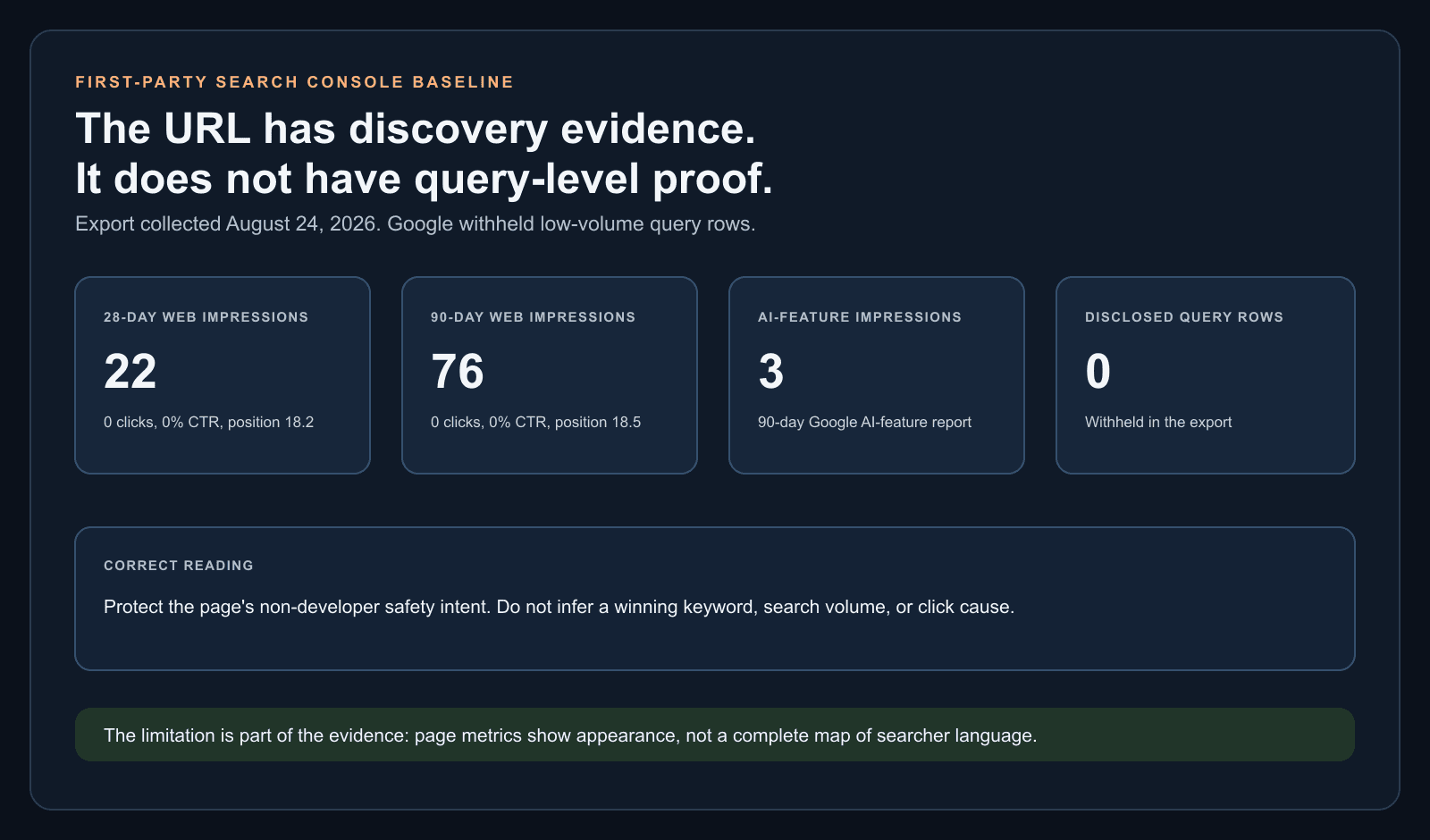
| Window | Web impressions | Clicks | Average position | What it supports |
|---|---|---|---|---|
| Latest 28 days on August 24 | 22 | 0 | 18.2 | The page was surfaced in Google Web search |
| Latest 90 days on August 24 | 76 | 0 | 18.5 | A directional view of longer-window discovery |
| Google AI-feature report, 90 days | 3 | Not supplied | Not supplied | Limited AI-feature visibility, not citation or click attribution |
Current US SERPs reward proof, tools, and demonstrations more than a generic how-to
A dated four-query sample shows a crowded result set where a safety contract is a sharper job than another promise to automate SEO.
On September 16, 2026, we collected US English desktop Google Organic Live results through DataForSEO for claude code seo workflow, claude code seo, claude code mcp seo, and vibe marketing seo. Every sampled query returned an AI Overview. The first three also returned a video carousel; vibe marketing seo returned People Also Ask and a video carousel.
The Claude Code queries surfaced YouTube demonstrations, GitHub projects, skills, tool pages, Reddit discussions, and broad tutorials. The vibe-marketing query surfaced definition-led guides, LinkedIn commentary, and agency pages. That makes a vague 'use Claude for SEO' article easy to replace. The defensible role for this URL is a non-developer operating contract: choose a read-only question, confirm the tool boundary, preserve evidence, and hand public actions to a named owner.
DataForSEO reported a monthly US search volume of 90 and keyword difficulty of 8 for claude code seo in this collection. It did not return a matching metric row for the other three exact strings. The metric is useful context for one phrase only; it is not a market-size estimate for Claude Code SEO or vibe marketing.
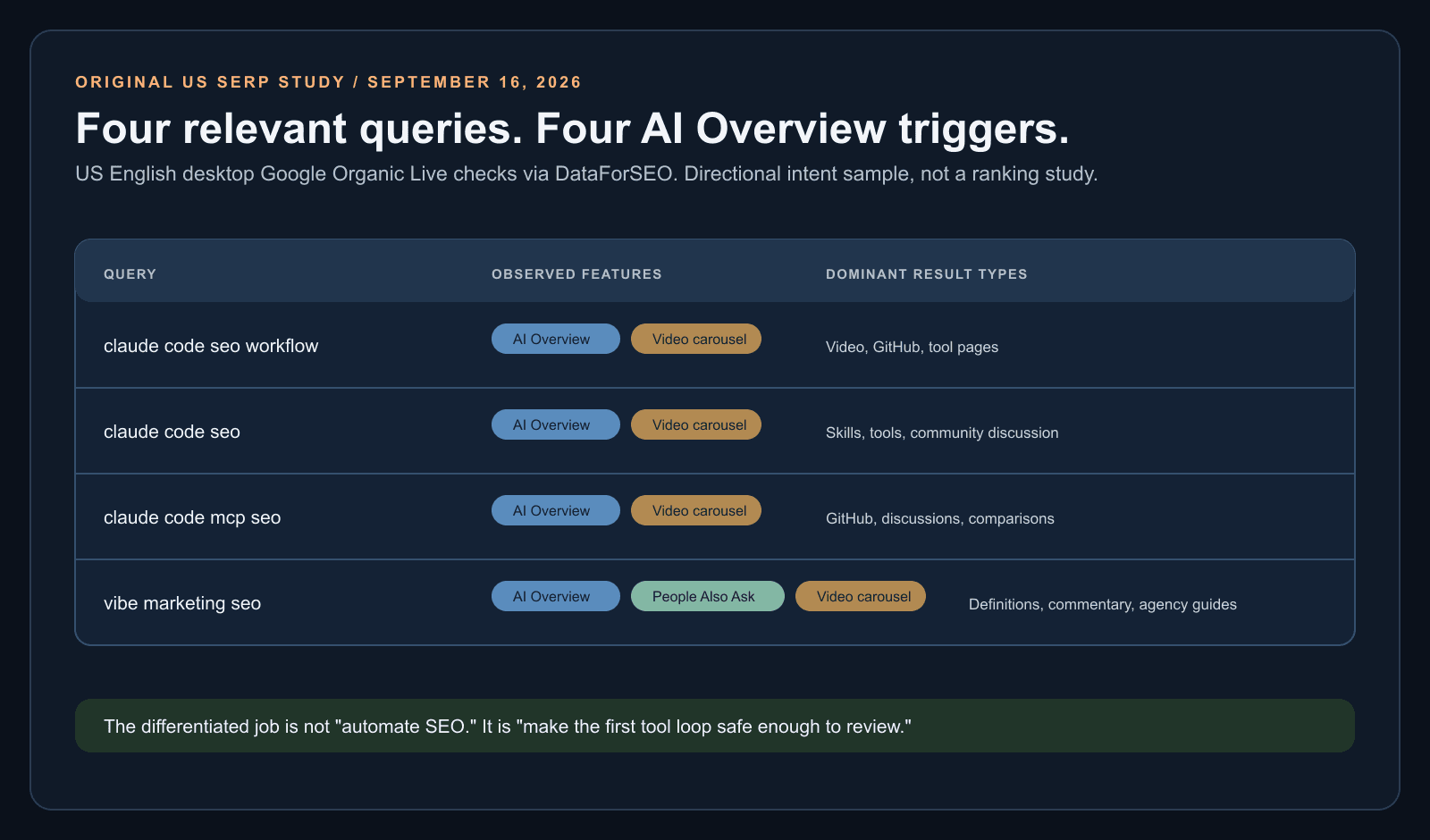
| Query | Observed features | Dominant result types | Reader job this page should own |
|---|---|---|---|
| claude code seo workflow | AI Overview, video carousel | Video demonstration, GitHub project, tool pages | Choose one bounded workflow before execution |
| claude code seo | AI Overview, video carousel | Skills, tool pages, community discussion | Tell a tool workflow from a content-generation shortcut |
| claude code mcp seo | AI Overview, video carousel | GitHub, community questions, tool comparisons | Set a narrow MCP access and review boundary |
| vibe marketing seo | AI Overview, People Also Ask, video carousel | Definitions, commentary, agency guides | Protect production while moving from idea to evidence |
Separate the marketer loop from the production loop
This guide owns the operating boundary; the technical guide owns connection, verification, and monitoring.
The two Claude Code jobs should not be collapsed into one giant tutorial. A marketer first needs to know what Claude may inspect, when it must stop, and who decides what happens next. An implementer needs the connection commands, discovery checks, failure tests, and monitoring path. Combining both makes the safe boundary harder to find and repeats setup material for readers who are not ready to use it.
Use this page to choose a bounded first workflow and its review contract. When that loop earns trust, move to the implementation guide to connect AgentSEO, verify the MCP surface, preserve the tool sequence, and decide whether the loop deserves monitoring.
| Reader job | This guide owns | Technical guide owns |
|---|---|---|
| Choose a first use case | Read-only research or triage | Not the primary job |
| Set safety boundaries | Allowed tools, stop conditions, human owner | Key handling and configuration scope |
| Prove the connection | Uses only the result and its limits | MCP setup, discovery, and verification |
| Move toward production | Defines the approval handoff | Captures execution, failures, and monitoring |
Use MCP so Claude can see real state
The big shift is not that Claude Code writes better. It is that Claude can call a real SEO tool instead of inferring everything from the open web.
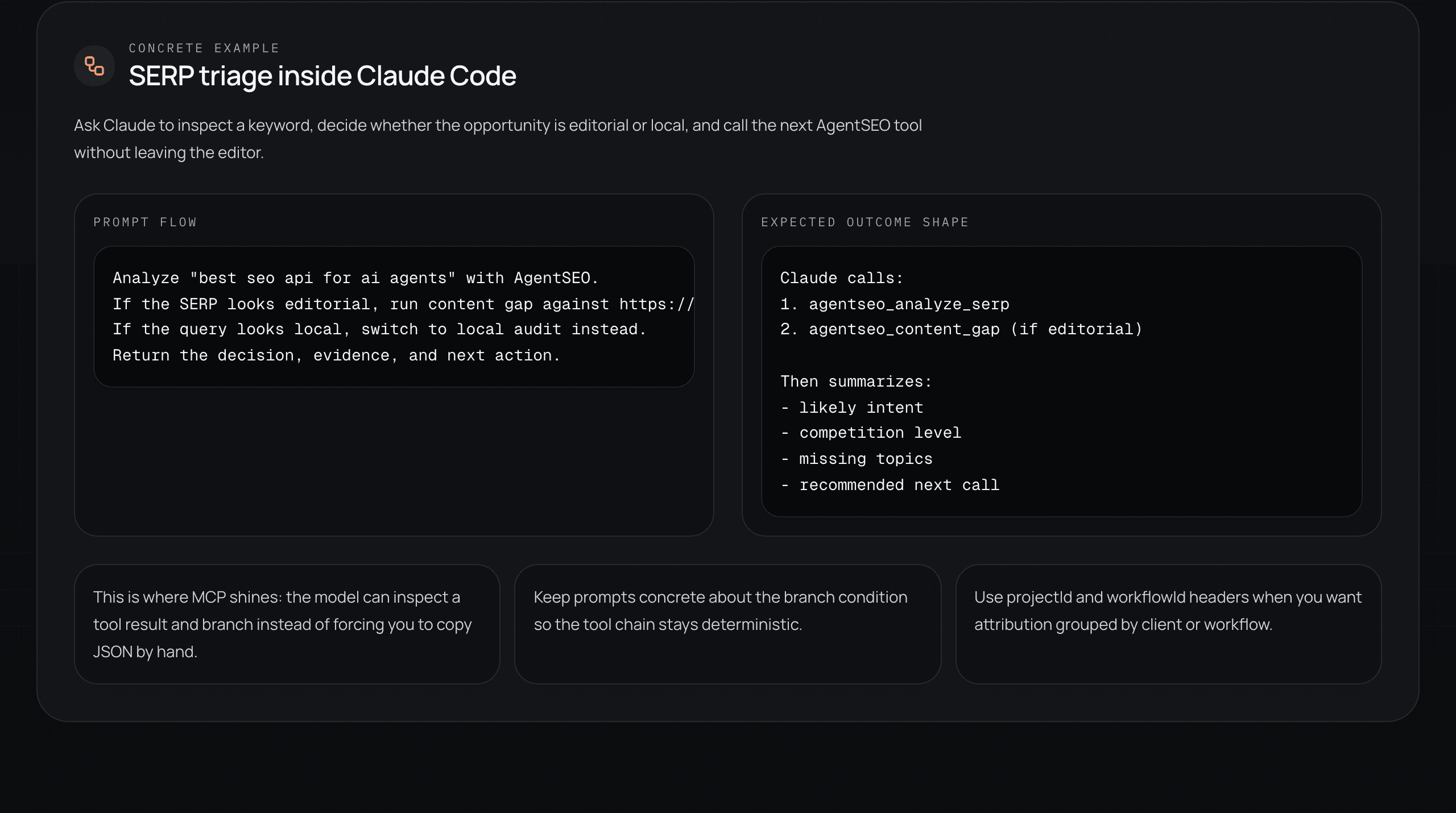
This is the practical value of AgentSEO inside Claude Code. Through hosted or local MCP, Claude can inspect a SERP, run a content-gap check, or pull another workflow signal directly. The reasoning gets better because the model is not pretending scraped pages are the whole truth.
It also makes the next step more deterministic. Claude can read one tool result, choose a branch condition, and call the next step. That is much stronger than pasting exports into chat and hoping the summary still holds together.
Related reading
MCP vs API: when REST still wins for SEO workflows
Use this if the team still needs the architectural boundary between editor-native tool calling and backend execution to be clearer.
What should be measured in the playground before building a production workflow
Use this before wiring a Claude Code idea deeper into production so the workflow gets validated properly first.
- Use hosted or local MCP so Claude can call AgentSEO directly.
- Pass concrete project and workflow context where needed.
- Prompt the branch condition explicitly so the loop stays inspectable.
- Treat MCP as a way to ground decisions, not as hype on its own.
Use AgentSEO in Claude Code to inspect the query "best seo api for ai agents".

1. Run the right search-intelligence tool first.
2. Decide whether the opportunity is editorial or local.
3. If editorial, run content gap against https://www.agentseo.dev/.
4. If local, stop and say this should move to a local workflow.
5. Return:
   - diagnosis
   - evidence
   - next action
- what should stay manualKeep production outside the first loop
Claude Code is strongest when it prepares or routes work, not when it silently owns the final public state.
This is where teams get into trouble. Once the loop feels powerful, it is tempting to let it run all the way into publish decisions, comparison framing, or production edits. That is usually too much too early.
A safer model is to let Claude Code produce the research summary, the opportunity diagnosis, the draft brief, or the next action. Then let a person or a more controlled workflow own the final public state.
- Keep strategy and final publish decisions outside the initial Claude Code loop.
- Use review gates for any claim-heavy or buyer-facing asset.
- Treat Claude Code as a workflow surface, not a permission slip.
- Make sure someone still owns the go or no-go decision visibly.
Use a safety card before Claude runs the loop
A short contract makes the allowed work, stop condition, evidence, and human handoff visible before the session starts.
The safest prompt is not just a clever instruction. It is attached to an operating contract. The contract below allows two read-only AgentSEO calls, prohibits public changes, stops when evidence is missing or the opportunity is local, and gives one named person responsibility for the next decision.
This is a reusable operator artifact, not proof that every Claude Code session will follow the contract perfectly. The reviewer still has to inspect the selected tools, the returned evidence, and the proposed next action. If Claude chooses an unlisted tool or cannot show the evidence, the correct result is stop—not improvise.
Related reading
Download the full Claude Code SEO safety card
Reuse the machine-readable contract with its evidence references, review questions, pass criteria, and limitations.
Add a durable review gate before a consequential action
Use this when a proven read-only loop begins handing work to publishing, redirects, outreach, or another public system.
{
  "workflow": "editorial-opportunity-triage",
  "mode": "read_only",
  "question": "Is this query an editorial opportunity for this site?",
  "allowed_tools": [
    "agentseo_analyze_serp",
    "agentseo_content_gap"
  ],
  "stop_if": [
    "the intent is local rather than editorial",
    "required evidence is missing",
    "Claude selects a tool outside the allowed list",
    "the next action would change a public system"
  ],
  "return": [
    "diagnosis",
    "supporting evidence",
    "limitations",
    "recommended next action",
    "what must stay manual"
  ],
  "production_actions_allowed": false,
  "human_owner": "named-marketing-owner"
}A prompt boundary is useful. A permission boundary is what enforces it.
A safety card tells the model and reviewer what should happen. Claude Code permissions and controlled environments decide what can happen.
Do not mistake a careful prompt for access control. Claude Code documents separate permissions for reading, shell use, file modifications, MCP tools, and external systems. Its rules can allow, ask, or deny a specific tool or command. Use that control surface when the work touches a repository, an API key, a deployment, or a client system.
For a first SEO run, keep the task read-only, grant only the named MCP tools needed for the question, and leave production services outside the allowed surface. Review the tool list in Claude Code before the run. If the workflow needs a write, create a separate deliberate handoff with a human owner, a change preview, validation criteria, and a rollback path.
This is not a claim that a permission setting makes an SEO conclusion correct. Permissions reduce the scope of a mistake. The reviewer still has to inspect the evidence, whether the tool was appropriate, and whether the proposed action fits the business context.
Related reading
- Read-only research: allow only the specific analysis tools the question requires.
- Draft or code changes: require a separate review of the diff before any merge or publish step.
- External actions: keep outreach, spend, redirects, deployments, and production data writes out of the first loop.
- Unknown result or unlisted tool: stop, record the gap, and revise the contract instead of expanding access mid-session.
Know what the current evidence proves
The current AgentSEO check supports tool discovery and the sample tool names, not authenticated execution or decision quality.
On September 16, 2026, we initialized AgentSEO's public hosted MCP endpoint and ran a public `tools/list` request. The server reported protocol version 2025-06-18 and 45 tool definitions. The returned catalog included `agentseo_analyze_serp` and `agentseo_content_gap`, the two tools named by the example safety card. That makes the contract concrete and reproducible at the discovery layer.
The check did not use a private API key, run the example workflow inside Claude Code, or score whether Claude selected the right tool. Those are later validation layers. Treat discovery, authenticated execution, recommendation quality, and permission to act as four separate gates.
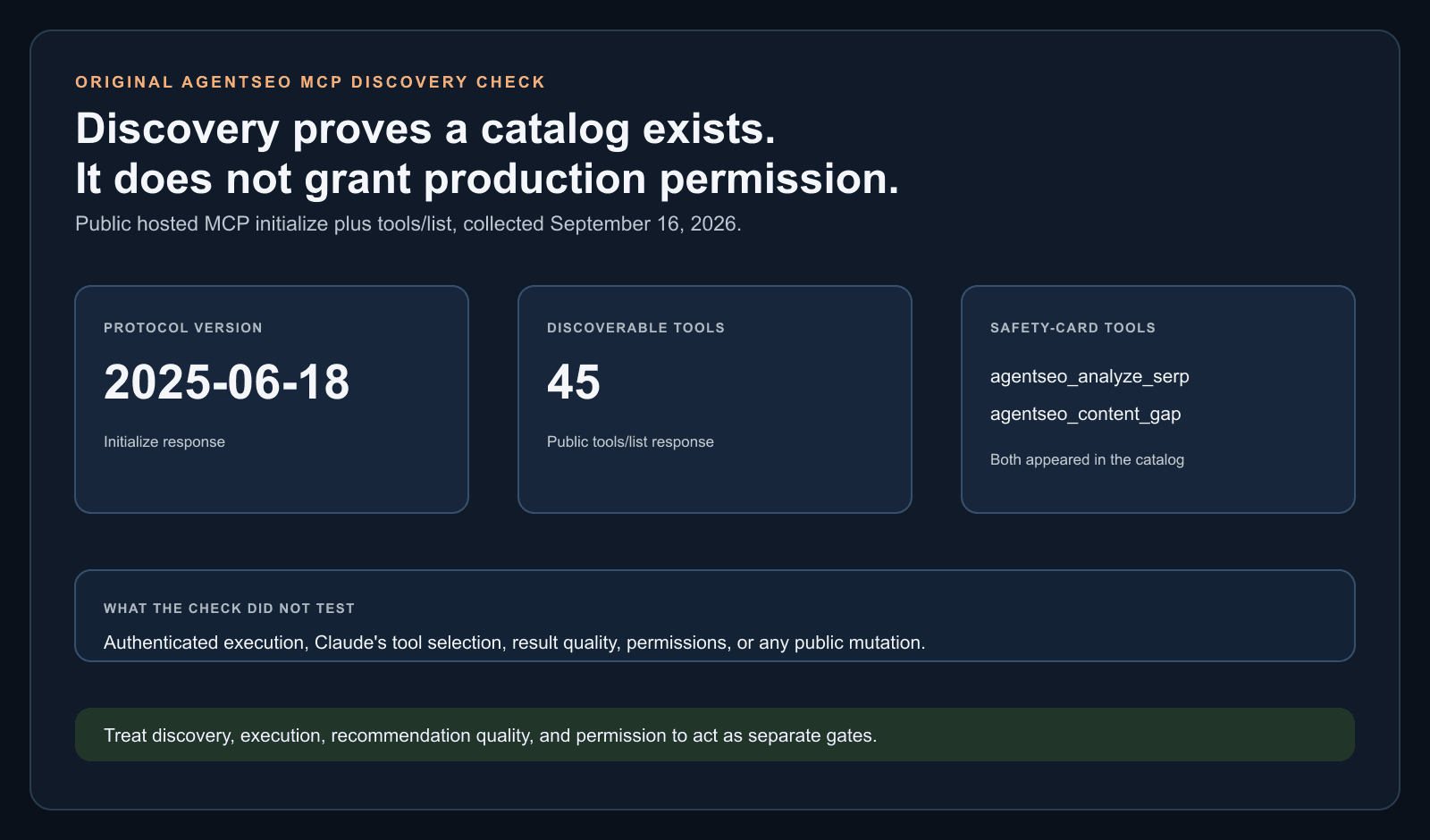
| Layer | September 16 status | Safe conclusion |
|---|---|---|
| Public MCP discovery | Passed; 45 tool definitions returned | Claude-compatible hosts can discover the catalog |
| Allowed sample tools | Both names appeared in the catalog | The safety card references real discoverable tools |
| Authenticated execution | Not tested in the public check | Requires a private bounded run |
| Claude tool selection | Not tested | Inspect every early run |
| Production permission | Explicitly false | A human or controlled gate owns any public change |
Pick one boring win first
The safest first use case is a boring repeatable loop that saves real time every week.
The strongest first Claude Code workflow is usually small. Analyze this query. Decide whether the opportunity is editorial or local. If editorial, run content gap. If not, stop. Or inspect this page class, summarize what changed, and return a short queue of next actions.
This matters because the first win shapes trust. If the first loop is narrow and useful, the team learns where Claude Code actually helps. If the first loop is too ambitious, the whole thing starts to feel unstable fast.
Where AgentSEO fits
AgentSEO fits as the structured SEO tool layer inside Claude Code, not as another document generator.
AgentSEO gives Claude Code direct access to SEO workflows over hosted or local MCP so the model can inspect a SERP, branch into another check, and return something a marketer can act on.
Used that way, Claude Code becomes a real workflow surface for SEO work without pretending it should own the whole production stack.
Keep the workflow moving
Use Claude Code as a real SEO workflow surface
AgentSEO gives Claude Code structured SEO tool access over hosted or local MCP so the model can inspect, branch, and return usable next actions instead of guessing from scraped pages.

Daniel Martin
Cofounder, AgentSEO
Inc. 5000 Honoree and cofounder of AgentSEO and Joy Technologies. Daniel has helped 600+ B2B companies grow through search and now writes about practical SEO infrastructure for AI agents, MCP workflows, and REST-first execution systems.
Continue this path
Builder-marketers using Claude Code
Start with the safest Claude Code workflow path, then move into monitored loops and the builder-marketer operating model.
Phase 3
Claude Code + AgentSEO: the fastest path from prompt to monitored workflow
The real Claude Code opportunity is not one-off prompting. It is turning one useful SEO question into a grounded workflow the team can repeat, review, and monitor.
Phase 3
What a builder-marketer workflow looks like with Claude Code, AgentSEO, and docs
The builder-marketer edge is not pretending to be a full engineering team. It is using prompts, docs, tool calls, and small internal builds to ship organic growth work faster.
FAQ
Questions teams usually ask next
What is the safest first Claude Code workflow for marketers?
Usually a narrow research or triage loop such as SERP inspection, content-gap branching, or workflow prototyping with a clear human review step after it.
Why use MCP with Claude Code for SEO workflows?
Because it lets Claude call real tools directly instead of inferring everything from scraped pages and generic web context.
Should Claude Code publish SEO content directly?
Not as the first step. It is usually better to let Claude Code prepare research, structure, and recommendations while a human or controlled workflow owns final publication.
More in this topic
Claude Code and builder-marketer workflows
Architecture
MCP vs API: when REST still wins for SEO workflows
Most teams do not need to choose between MCP and APIs. Keep REST for durable SEO execution. Add MCP when Claude Code or another agent host should call the same workflow natively.
Claude Code
Claude Code + AgentSEO: the fastest path from prompt to monitored workflow
The real Claude Code opportunity is not one-off prompting. It is turning one useful SEO question into a grounded workflow the team can repeat, review, and monitor.