Claude Code + AgentSEO: the fastest path from prompt to monitored workflow
The real Claude Code opportunity is not one-off prompting. It is turning one useful SEO question into a grounded workflow the team can repeat, review, and monitor.
Hybrid builder-marketers and vibe marketers who want to turn Claude Code experiments into repeatable SEO workflows
Claude Code / workflow design
Best Next Step
Turn one good Claude Code prompt into a workflow worth keeping
AgentSEO helps Claude Code inspect real SEO signals, branch into the next check, and produce loops the team can later monitor instead of redoing by hand.
Quick Brief
Best For
Hybrid builder-marketers and vibe marketers who want to turn Claude Code experiments into repeatable SEO workflows
Core Problem
The real Claude Code opportunity is not one-off prompting. It is turning one useful SEO question into a grounded workflow the team can repeat, review, and monitor.
Read Shape
12 min read with scannable sections, proof blocks, and direct next actions.
Proof Inside
You’ll Cover
- Start with one real question
- Use AgentSEO for grounded branching
- Connect AgentSEO to Claude Code and verify the tools
Most teams stop too early with Claude Code. They prove the model can answer one question, maybe call one tool, and treat that as the win. It is not.
The real win is turning one useful question into a loop the team can keep running and trust. AgentSEO helps because Claude Code can inspect a SERP over MCP, branch into the next tool call, and return a recommendation that is structured enough to keep.
Start with one real question
The first step is not a giant agent. It is a concrete question that the team already asks often.
The best Claude Code workflows usually begin with a very normal operator question. Is this query worth a comparison page. Did this page class lose visibility because of extractability or weak positioning. Which prompt set needs monitoring next.
That kind of question is specific enough for a tool loop and useful enough to matter after the demo. If the opening prompt is vague, the workflow usually stays vague too.
- Pick a repeated question from the real operating rhythm.
- Keep the scope narrow enough to inspect in one session.
- Define what a good output should help the team decide.
- Avoid starting with a full content-generation task.
Use AgentSEO for grounded branching
Claude Code gets much more useful when the model can read a real result and decide what tool should come next.
This is the core shift. Instead of asking Claude to reason from scraped pages and intuition, let it call AgentSEO over hosted or local MCP. The model can inspect a SERP, decide whether the opportunity is editorial or local, branch into content gap or another check, and return a compact summary with the next action.
That is what makes the workflow feel operational. The model is not just generating text. It is making a bounded decision on top of structured evidence.
Related reading
How vibe marketers can use Claude Code for SEO workflows without breaking production
Use this first if the team still needs the safer operating boundary for Claude Code before trying to push it toward a repeatable loop.
MCP vs API: when REST still wins for SEO workflows
Use this when you need the architectural split between editor-native tool calling and backend execution to stay clear.
- Use MCP so Claude can call the tool directly.
- Make the branch condition explicit in the prompt.
- Keep the output compact and action-oriented.
- Prefer deterministic next steps over open-ended ideation.
Use AgentSEO to inspect the query "best seo api for ai agents".

1. Run the appropriate search-intelligence tool first.
2. Summarize whether the query is better served by a comparison page, docs page, or blog post.
3. If comparison intent is dominant, suggest the exact next workflow I should run.
4. Return:
   - one-sentence diagnosis
   - evidence from the result
   - recommended next action
- what should stay manualConnect AgentSEO to Claude Code and verify the tools
Use the hosted HTTP endpoint for the shortest setup path, then verify discovery before running an SEO workflow.
Claude Code's current MCP documentation recommends HTTP for cloud-hosted servers and reserves stdio for local child processes. AgentSEO supports both. The hosted path avoids running a local wrapper; the npm package remains useful when the client or environment needs stdio.
The command below uses the hosted endpoint. Use a server-side AgentSEO key, keep it out of source control, and choose the appropriate Claude Code configuration scope. After adding the server, verify it from the CLI and the `/mcp` panel before asking Claude to call a tool.
Related reading
claude mcp add --transport http agentseo https://www.agentseo.dev/mcp \
  --header "Authorization: Bearer sk_live_your_key" \
  --header "x-project-id: client-alpha" \
  --header "x-workflow-id: seo-monitoring"

claude mcp get agentseo
claude mcp list

# Inside Claude Code, open the server panel:
/mcpVerify the production endpoint before the first workflow
A public discovery check confirms the transport, protocol, and tool catalog without pretending a successful tools/list call proves the authenticated workflow.
On August 24, 2026, the AgentSEO production server card reported a Streamable HTTP endpoint at `/mcp`, protocol version 2025-06-18, and 45 tools. A direct public `tools/list` request returned the same 45 tools with input schemas. Authenticated tool execution still requires an API key.
This is the first verification layer only. Next, Claude Code should run one bounded prompt, capture the tools it selected, preserve the output, and record whether a human accepted the recommendation. Discovery, execution, and decision quality are three different checks.
Related reading
curl -sS -X POST https://www.agentseo.dev/mcp \
  -H "content-type: application/json" \
  -H "accept: application/json, text/event-stream" \
  -H "mcp-protocol-version: 2025-06-18" \
-d '{"jsonrpc":"2.0","id":1,"method":"tools/list","params":{}}'| Check | August 24 result | What it proves |
|---|---|---|
| Server card | Available | Endpoint and declared capabilities are discoverable |
| Transport | Streamable HTTP | Matches Claude Code's recommended remote-server path |
| Protocol | 2025-06-18 | The current production protocol declaration |
| tools/list | 45 tools returned | Tool names and schemas are discoverable |
| Authenticated tool call | Not part of public discovery | Must be tested with a private key and bounded prompt |
Capture the workflow shape before you automate it
The first repeated win is usually a human-in-the-loop loop that proves what should later be monitored.
Once Claude Code returns a result that actually helps, do not jump straight to automation. Capture the workflow shape first. What was the input. What tool calls happened. What branch condition mattered. What summary was genuinely useful. What downstream action followed.
That gives the team something real to evaluate. It is also where the playground and docs matter. Before building a larger runner, confirm that the output shape, latency, and actionability hold up outside the one lucky session.
Related reading
What should be measured in the playground before building a production workflow
Use this to validate the response shape and operational fit before the team promotes a Claude Code loop into something larger.
What to automate first if you want SEO leverage without content chaos
Use this to keep the first monitored workflow focused on signal and routing instead of overreaching into production too early.
- Document the exact loop that produced the useful result.
- Preserve the prompt, tool sequence, and branch condition.
- Check whether the output is reusable or was only lucky once.
- Treat repeatability as the gate into monitoring.
{
  "diagnosis": "Comparison intent is stronger than educational intent for this query family.",
  "evidence": [
    "SERP titles are comparison-led",
    "multiple results frame vendor tradeoffs directly",
    "docs pages are present but not leading"
  ],
  "recommended_next_action": "Draft a comparison-page brief and monitor citation presence weekly.",
  "keep_manual": "final positioning language and proof claims"
}Move from session win to monitored loop
A workflow deserves monitoring when it answers a recurring question and the output can route a next action reliably.
The monitored version does not have to keep running inside Claude Code. In many cases, Claude Code is where the team discovers the loop, and another system is where the loop runs repeatedly.
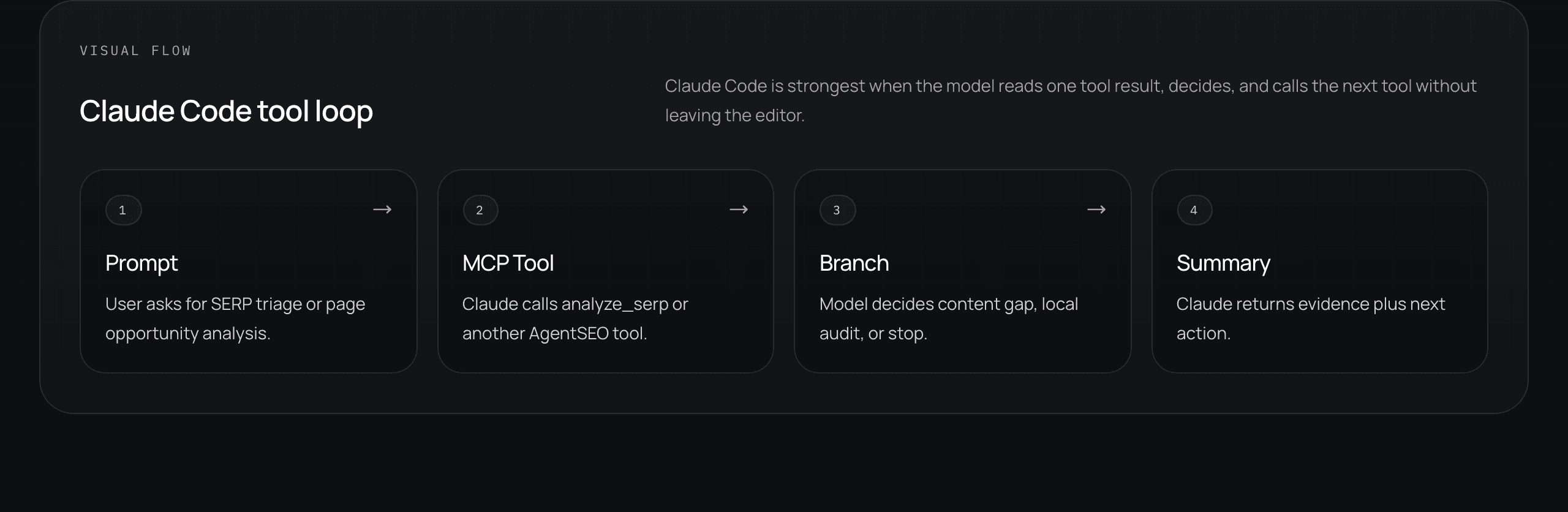
That is the healthy path. Prompt, tool call, branch, summary, repeated question, monitored workflow. Not because every loop should become production. Because the good ones should stop being reinvented every week.
Where AgentSEO fits
AgentSEO fits as the structured search-intelligence layer that helps Claude Code graduate from an interesting prompt to a usable workflow.
AgentSEO gives Claude Code grounded SEO tools over MCP and gives the team a cleaner path from one prompt session into a repeated workflow. Less guessing. Better branching. Cleaner handoff into something the team can actually monitor.
That is the difference between a novelty and an operating advantage.
Keep the workflow moving
Turn one good Claude Code prompt into a workflow worth keeping
AgentSEO helps Claude Code inspect real SEO signals, branch into the next check, and produce loops the team can later monitor instead of redoing by hand.

Daniel Martin
Cofounder, AgentSEO
Inc. 5000 Honoree and cofounder of AgentSEO and Joy Technologies. Daniel has helped 600+ B2B companies grow through search and now writes about practical SEO infrastructure for AI agents, MCP workflows, and REST-first execution systems.
Continue this path
Builder-marketers using Claude Code
Start with the safest Claude Code workflow path, then move into monitored loops and the builder-marketer operating model.
Phase 3
How vibe marketers can use Claude Code for SEO workflows without breaking production
Use Claude Code for SEO without risking production: choose a read-only loop, restrict MCP tools, preserve evidence, and put a human gate before public changes.
Phase 3
What a builder-marketer workflow looks like with Claude Code, AgentSEO, and docs
The builder-marketer edge is not pretending to be a full engineering team. It is using prompts, docs, tool calls, and small internal builds to ship organic growth work faster.
FAQ
Questions teams usually ask next
What is the first sign that a Claude Code workflow is worth keeping?
It answers a recurring question with structured evidence and produces a next action the team would actually use again next week.
Does the monitored workflow need to keep running inside Claude Code?
Not necessarily. Claude Code is often the discovery surface. A later runner or monitored system may own the repeated execution.
Why use AgentSEO in this loop instead of generic web research?
Because grounded tool outputs give Claude Code something real to inspect and branch on instead of forcing the model to guess from scraped pages and loose context.
More in this topic
Claude Code and builder-marketer workflows
Architecture
MCP vs API: when REST still wins for SEO workflows
Most teams do not need to choose between MCP and APIs. Keep REST for durable SEO execution. Add MCP when Claude Code or another agent host should call the same workflow natively.
Claude Code
How vibe marketers can use Claude Code for SEO workflows without breaking production
Use Claude Code for SEO without risking production: choose a read-only loop, restrict MCP tools, preserve evidence, and put a human gate before public changes.