SEO agent guide: how to build one without breaking production
Build an SEO agent with a bounded job, typed workflow state, validation, retry limits, and a human gate before it changes production.
Builders shipping agent-assisted SEO products or internal tools
SEO agents / automation
The fastest way to make an SEO agent unsafe is to ask it to research, decide, edit, and publish in one pass. The model may sound confident. Your trace will still be useless when the data is wrong, the tool fails, or the action needs a rollback.
Build a smaller system first: one repeatable SEO job, typed evidence, a validation step, a retry budget, and an explicit route to a human when the decision is uncertain or consequential.
Best Next Step
Start with one inspectable SEO agent loop
Use AgentSEO endpoints in the playground to prototype one bounded workflow, then wire it into your queue, runtime, or MCP surface.
What an SEO agent actually is
The phrase sounds broad, but the useful version is much narrower and more operational.
An SEO agent is a workflow that gathers search evidence, reaches a bounded recommendation, and routes the next permitted action. It is not a chatbot with a keyword API attached, and it is not a substitute for an SEO team.
The practical version has three visible layers: collection, decision, and routing. That lets an operator inspect what the system saw, why it made a recommendation, and whether anyone is allowed to act on it. One giant autonomous SEO operator cannot provide that clarity.
| Layer | What it does | What good looks like |
|---|---|---|
| Collection | Gets rankings, SERP features, citations, or page signals | Inputs are stable and rerunnable |
| Decision | Summarizes what changed and what probably matters | The recommendation is inspectable |
| Routing | Sends the next action to a person or system | No risky action happens without a clear gate |
Our Search Console baseline supports this build intent, not a keyword retarget
The page has a small but real first-party discovery signal. The disclosed query does not describe the article's intended job.
Our August 24 Search Console export recorded one click from six Web-search impressions over the latest 28 days, with a 16.7% CTR and average position 33.2. Over 90 days, it recorded one click from 11 impressions, 9.1% CTR, and average position 23.9.
Google exposed one query row in both windows: does agent fire have good seo, with one impression and position 88. The clicked query was withheld. That visible row is unrelated brand ambiguity, not evidence that this guide should become an AgentFire review or broad SEO-software comparison. The honest move is to preserve the technical build intent and improve the page's implementation proof.
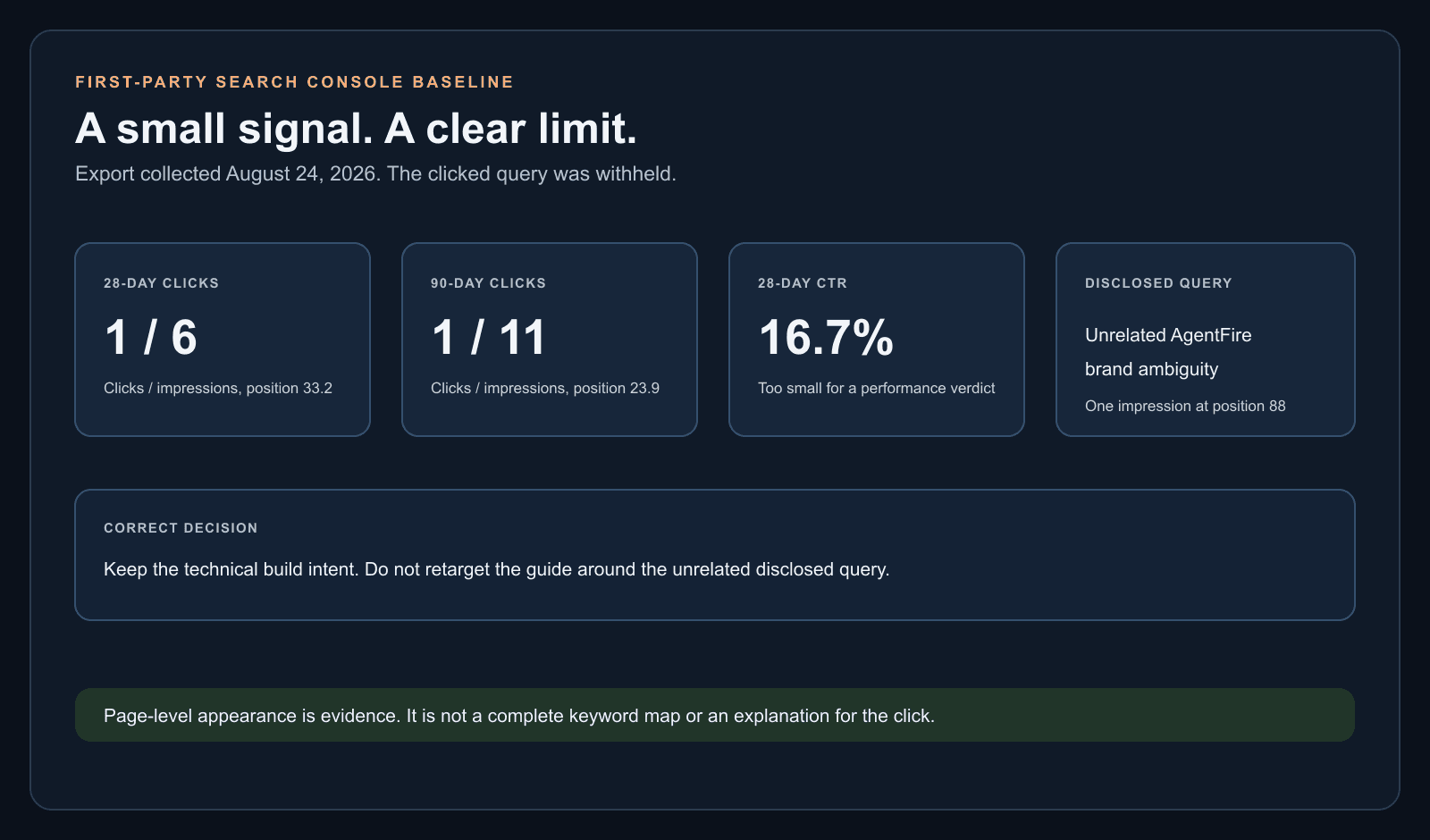
| Window | Clicks | Impressions | CTR | Average position | What it supports |
|---|---|---|---|---|---|
| Latest 28 days on August 24 | 1 | 6 | 16.7% | 33.2 | A small current discovery signal for this technical guide |
| Latest 90 days on August 24 | 1 | 11 | 9.1% | 23.9 | A directional longer-window baseline |
| Disclosed query row | 0 | 1 | 0% | 88 | Only that low-volume unrelated query appeared; it should not drive retargeting |
Current SERPs split product buyers from builders. This guide is for builders.
A fresh US SERP sample confirms that the head term is commercial, while the build query calls for a reproducible workflow and architecture.
On September 16, 2026, we collected US English desktop Google Organic Live results through DataForSEO for seo agent, how to build an seo agent, seo agent workflow, and ai seo agent. Every sampled query returned an AI Overview. The build and workflow queries also returned a video carousel; the broad commercial phrases returned People Also Ask, and ai seo agent also returned video.
The seo agent and ai seo agent results lean toward product pages, tool lists, agency framing, and opinion-led content. The build query leans toward a case study, video demonstration, community discussion, and implementation guide. This page should not chase the broad buyer query. It should help an engineer or growth builder choose one safe first job, define the state, and test the recovery behavior.
DataForSEO reported US monthly search volume of 27,100, CPC of $39.88, and keyword difficulty of 19 for seo agent. It reported 260 monthly searches, $25.59 CPC, and difficulty 17 for ai seo agent. Both are commercial-intent metrics in this collection. They explain why product pages dominate those phrases; they do not demonstrate demand for this tutorial or a conversion outcome for AgentSEO.
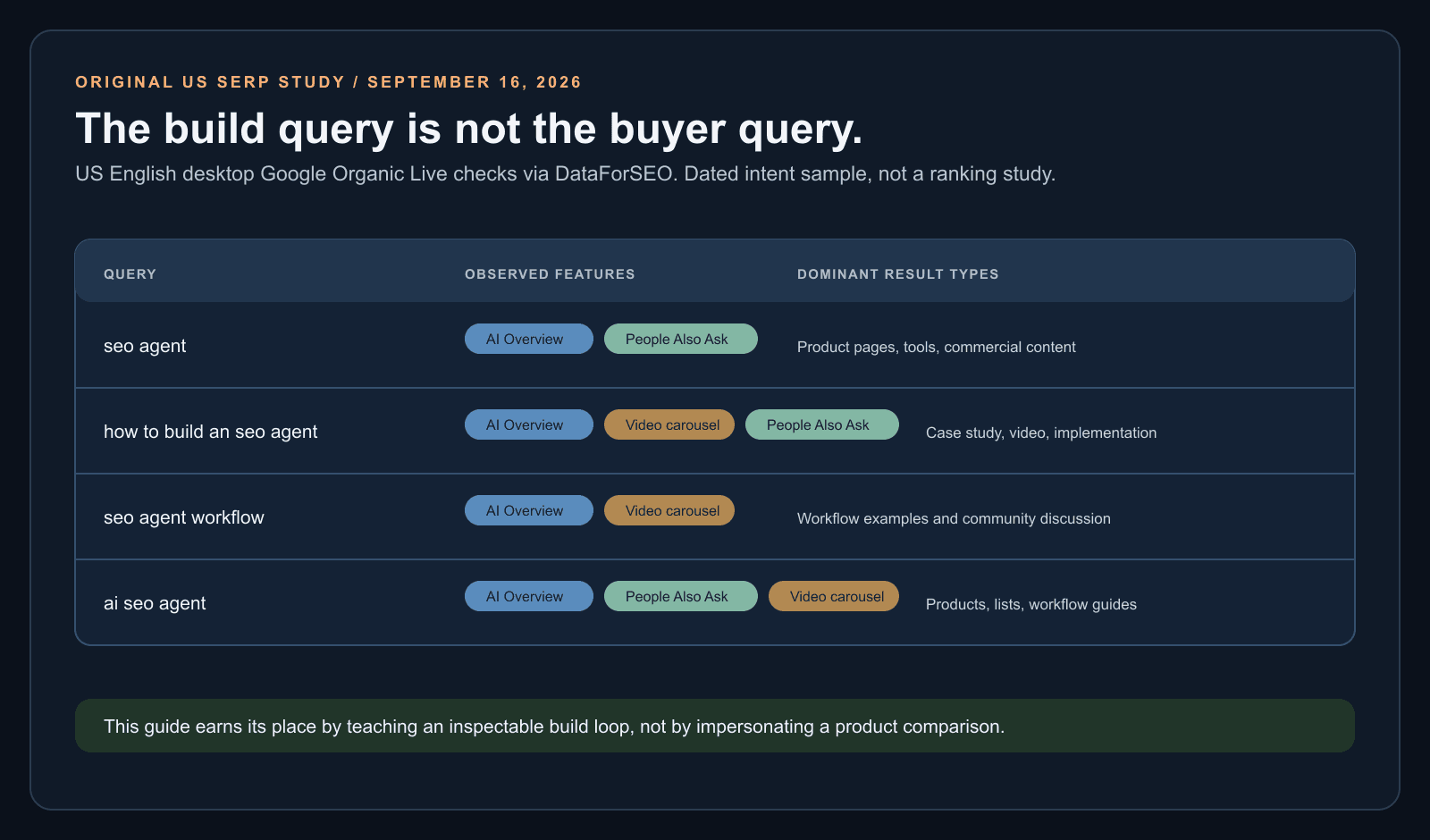
| Query | Observed features | Dominant result types | What this guide should do |
|---|---|---|---|
| seo agent | AI Overview, People Also Ask | Product pages, tool lists, agency and practitioner content | Do not turn a build guide into a generic tool comparison |
| how to build an seo agent | AI Overview, video carousel, People Also Ask | Case study, video, community discussion, implementation guide | Show a bounded build architecture and verification path |
| seo agent workflow | AI Overview, video carousel | Workflow examples, product material, community discussion | Give one concrete decision loop with an exit rule |
| ai seo agent | AI Overview, People Also Ask, video carousel | Product pages, tool lists, workflow guides | Explain where the data layer ends and review begins |
Pick the first SEO job carefully
The first workflow decides whether the team trusts the whole system later.
The best first SEO agent job is usually a monitoring or recommendation loop, not direct publishing. That keeps the blast radius low while still proving whether the data layer, prompts, and routing rules are good enough to use repeatedly.
For most teams, the early win is not a general agent. It is a bounded loop like rank-drop triage, content-decay review, comparison-page refresh suggestions, or weekly AI visibility monitoring.
Related reading
- Rank-drop detection on a fixed keyword set.
- Content refresh recommendations for aging pages.
- Comparison-page monitoring for competitor changes.
- AI visibility prompt monitoring across fixed query sets.
- Local or entity audit summaries that route into review.
Separate collection, decision, and action
The agent should not fetch, reason, and publish in one opaque leap.
Reliable SEO agent systems separate data collection, interpretation, and execution. That boundary keeps traces readable and gives operators a clean place to inspect the evidence before anything changes.
This matters because the cost of a wrong action is not only wasted content time. It can also create noisy experiments, poor reporting, false confidence in the automation, and pages that drift away from search intent.
1. Collect structured search evidence
2. Store the result with job state
3. Generate a recommendation with evidence attached
4. Route to a reviewer or guarded executor
5. Re-run on a stable cadence and compare outcomesDefine the workflow contract before the agent loop
A production agent needs a state shape that a queue, reviewer, and later run can inspect without reconstructing the prompt.
AgentSEO's repository uses a typed workflow contract instead of returning recommendation prose alone. The contract carries a bounded decision, normalized confidence, prioritized actions, supporting evidence, limitations, and allowed next calls. That is the minimum state I would preserve between steps.
The important design choice is that uncertainty stays visible. A limitation is not buried in a paragraph, and the next call is not invented by the runtime. This makes review, retries, and regression tests possible without asking an evaluator to infer the whole history.
type SeoAgentState = {
  summary: string;
  decision: "ready" | "act_now" | "monitor" | "blocker";
  confidence: number;
  recommended_actions: Array<{ priority: string; action: string; why: string }>;
  evidence: Array<{ finding: string; detail: string; severity: string }>;
  limitations: string[];
  next_calls: Array<{ endpoint: string; reason: string }>;
};| State | Route | Do not do |
|---|---|---|
| Valid and low risk | Record and queue the allowed next call | Expand scope during execution |
| Valid but consequential | Attach evidence and request human approval | Publish or redirect automatically |
| Tool error | Retry only if the error is retryable and budget remains | Retry every failure blindly |
| Invalid or uncertain | Revise once or route to review | Convert uncertainty into confidence |
| Retry budget exhausted | Stop safely and preserve the trace | Loop until something passes |
Test recovery and review routing before production
A deterministic simulation can expose control-flow tradeoffs before live users or pages absorb them.
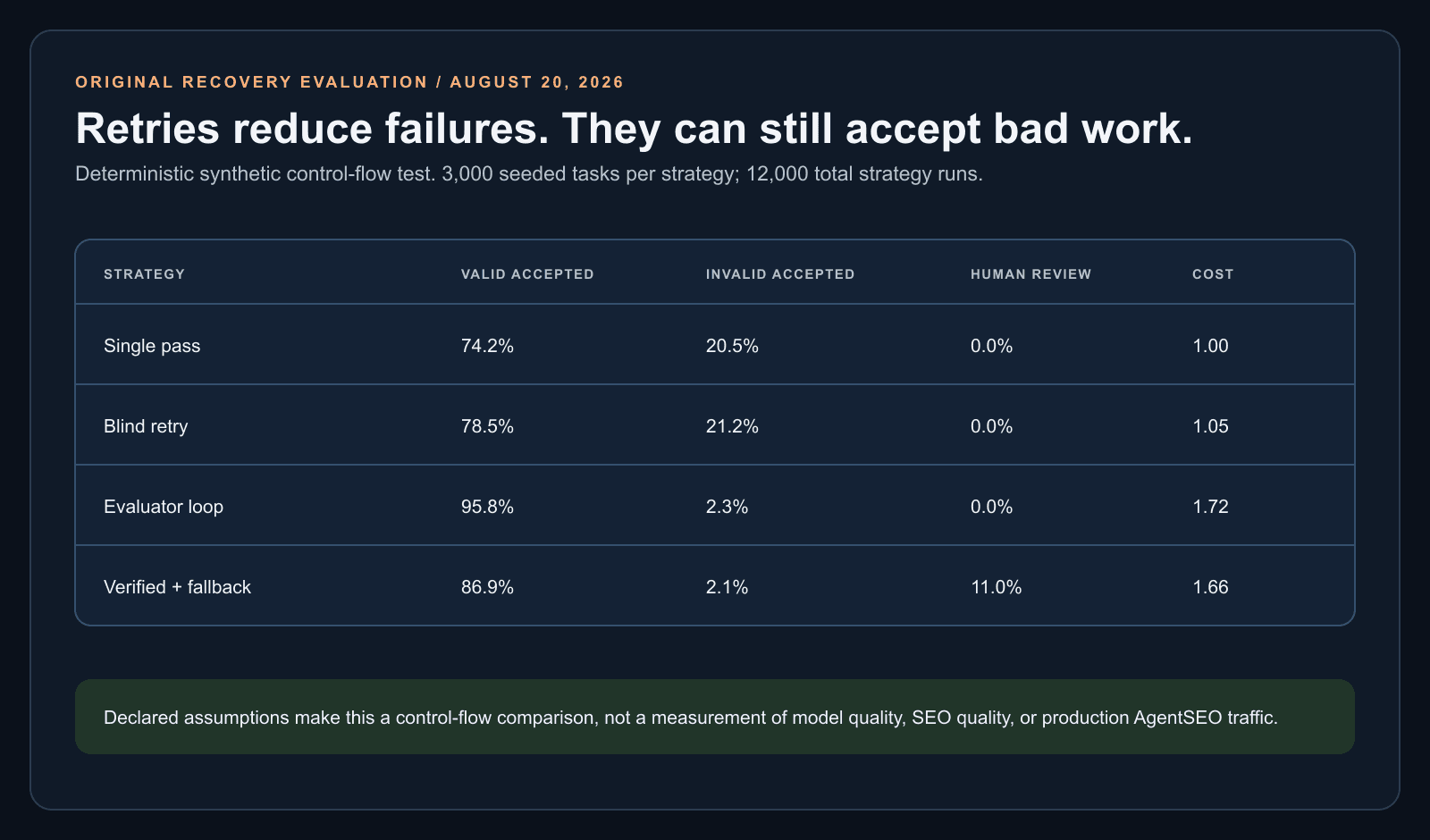
We ran the same 3,000 seeded synthetic tasks through four routing strategies: single pass, blind retry, evaluator loop, and verified fallback. Across 12,000 strategy runs, single pass accepted an invalid result in 20.5% of runs under the declared assumptions. Blind retry reduced hard failures but increased invalid acceptance to 21.2%.
The verified-fallback loop reduced invalid acceptance to 2.1%, routed 11.0% of runs to human review, and cost 1.66 simulated units on average versus 1.00 for single pass. The useful finding is not that these percentages predict production. It is that retries, evaluation, review, and cost must be tested together; optimizing only for fewer failures can make acceptance quality worse.
Related reading
Download the architecture and evaluation evidence
Inspect the workflow fields, seeded method, strategy results, reproducibility paths, and claim limitations as JSON.
Build the review gate after the recovery loop
Use this companion guide when you need the approval policy and reviewer handoff in more detail.
| Strategy | Valid accepted | Invalid accepted | Human review | Mean cost units |
|---|---|---|---|---|
| Single pass | 74.2% | 20.5% | 0.0% | 1.00 |
| Blind retry | 78.5% | 21.2% | 0.0% | 1.05 |
| Evaluator loop | 95.8% | 2.3% | 0.0% | 1.72 |
| Verified + fallback | 86.9% | 2.1% | 11.0% | 1.66 |
Choose the right tooling layer
The runtime matters less than the contract shape, but the tooling layer still changes what you have to build.
An SEO agent usually sits on top of a small stack: search intelligence, storage, orchestration, and a runtime that can call tools. MCP can be useful. REST can be useful. A queue can be useful. None of those choices save the system if the underlying signals are noisy or the output contract is hard to act on.
That is why I prefer to decide the workflow contract first, then choose the runtime that makes that contract easy to operate. If the agent needs rankings, AI Overview evidence, and a recommendation block, the important thing is that those arrive in a stable shape.
| Layer | Best for | What it should not pretend to solve |
|---|---|---|
| Search-intelligence API | Rankings, SERP features, content gaps, AI visibility signals | Final business judgment by itself |
| Runtime or tool layer | Calling tools and branching logic | Fixing bad source data |
| Queue and job state | Retries, scheduling, and traceability | Explaining SEO strategy |
| Reviewer or approval step | Risk control and final judgment | Replacing structured evidence |
Build guardrails before autonomy
Approval rules are part of the product, not a temporary inconvenience.
The strongest SEO agent experiences feel fast because the system knows which actions are safe to automate and which ones need review. Simple routing rules beat vague prompt instructions every time.
For most teams, the first autonomous actions should be low-risk tasks like tagging, queueing, notifying, or generating drafts. Publishing changes or reallocating budgets should stay gated until the evidence is trustworthy.
- Auto-run monitoring and classification tasks.
- Require review for content changes, redirects, or spend decisions.
- Attach evidence and confidence signals to every recommendation.
- Keep rollback and audit history obvious for every run.
Implement one traceable rank-drop loop before you add more tools
The useful first build is a small graph with visible state and a stop condition, not a general-purpose SEO assistant.
Start with a saved keyword and page set. Collect the rank-tracking result, validate its required fields, classify whether the movement deserves attention, and return a recommendation that keeps the raw evidence and limitations attached. If the result is incomplete, inconclusive, or consequential, stop and ask for review.
This structure works in a queue, a state graph, or a simple worker. The runtime is a later choice. The contract is the thing that keeps the workflow testable when the agent calls a provider, retries a failed request, or hands work to another system.
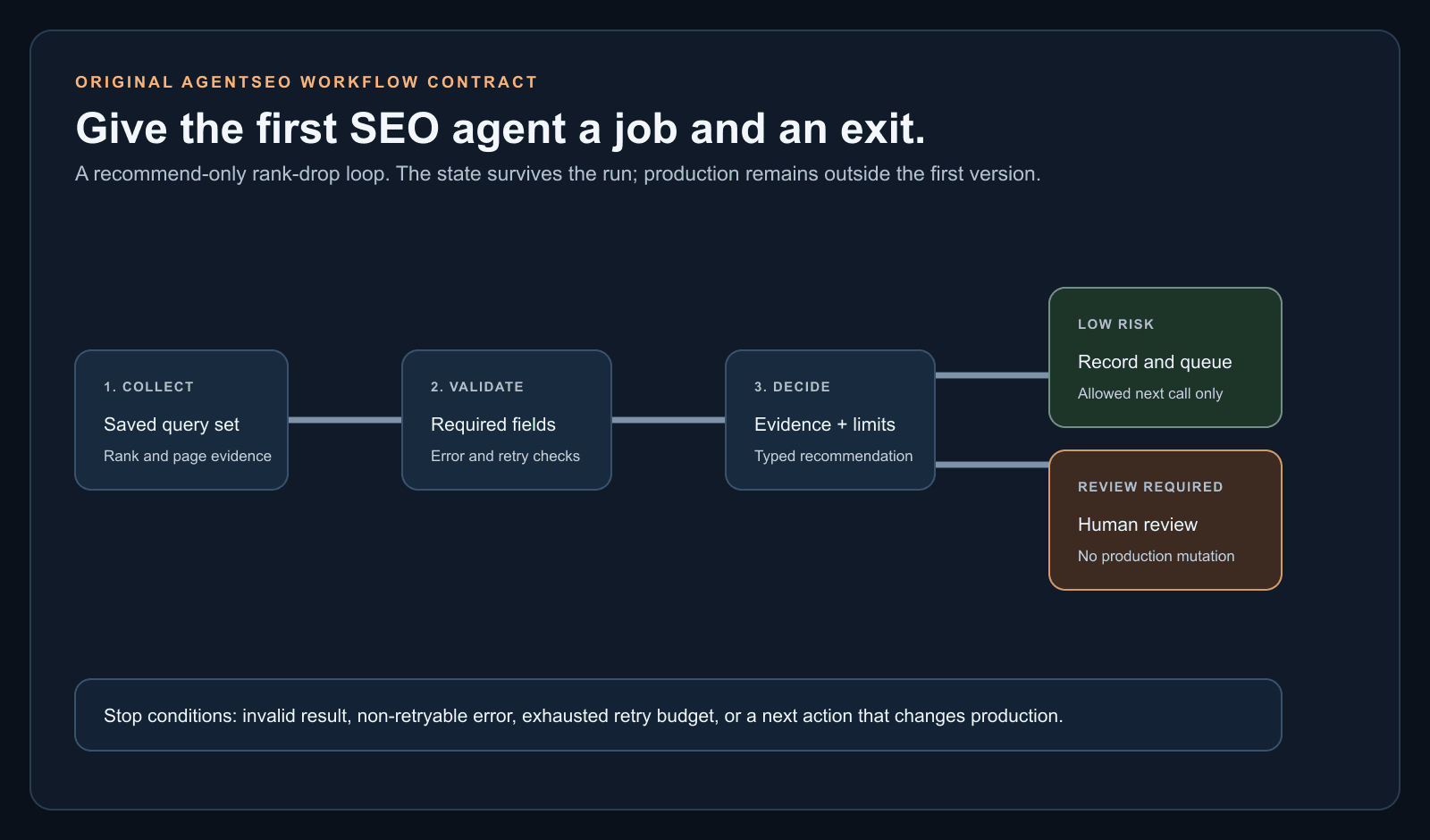
{
  "workflow": "rank-drop-triage",
  "mode": "recommend_only",
  "inputs": {
    "keyword_set": "[saved high-value queries]",
    "target_urls": "[mapped canonical URLs]",
    "location": "United States",
    "language": "en"
  },
  "required_output": [
    "decision",
    "confidence",
    "evidence",
    "limitations",
    "recommended_actions",
    "next_calls"
  ],
  "stop_if": [
    "the result is missing required fields",
    "the provider error is not retryable",
    "the retry budget is exhausted",
    "the next action changes production"
  ],
  "production_actions_allowed": false,
  "approval_owner": "[named operator]"
}Where AgentSEO fits in an SEO agent stack
AgentSEO fits when the team needs search-intelligence outputs that are easier for an agent or reviewer to use directly.
AgentSEO is not the whole SEO agent. It is the search-intelligence layer that gives the runtime rankings, SERP analysis, AI Overview extraction, content-gap evidence, and job-shaped outputs in a cleaner contract.
That makes it useful when the team wants to spend less time normalizing provider payloads and more time deciding what the workflow should do next. If the buying question is really about daily operation, that tradeoff matters.
Related reading
Best SEO API for AI agents
Use this if the tooling question is still unsettled and the team needs a buyer guide before it builds the runtime.
How to measure AI visibility
Use this when the first SEO agent job is prompt monitoring or answer-layer reporting instead of rank-only workflows.
Google AI Mode guide
Use this if the workflow needs to monitor Google's newer answer surfaces alongside classic search.
curl -s -X POST "https://www.agentseo.dev/api/v1/rank/track?sync=true" \
  -H "x-api-key: YOUR_AGENTSEO_API_KEY" \
  -H "content-type: application/json" \
  -d '{
    "keyword": "seo agent",
    "target_url": "https://www.agentseo.dev/blog/how-to-build-an-seo-agent",
    "location": "United States",
    "language": "en"
}'Keep the workflow moving
Start with one inspectable SEO agent loop
Use AgentSEO endpoints in the playground to prototype one bounded workflow, then wire it into your queue, runtime, or MCP surface.

Daniel Martin
Cofounder, AgentSEO
Inc. 5000 Honoree and cofounder of AgentSEO and Joy Technologies. Daniel has helped 600+ B2B companies grow through search and now writes about practical SEO infrastructure for AI agents, MCP workflows, and REST-first execution systems.
FAQ
Questions teams usually ask next
What is an SEO agent in simple terms?
An SEO agent is a workflow that gathers search signals, turns them into a recommendation, and routes the next action with enough evidence that a human or another system can trust it.
What is the best first SEO agent workflow?
A monitoring or recommendation workflow is usually the best first step. Rank-drop triage, content-decay review, and AI visibility monitoring are strong starting points because the risk is lower and the learning is fast.
Do I need MCP to build an SEO agent?
No. MCP can help with tool packaging and orchestration, but the core design matters more: bounded jobs, inspectable outputs, and clear handoffs between analysis and action.
Should an SEO agent publish content automatically?
Usually not at the start. Drafting, classification, and recommendation are safer early wins. Direct publishing should wait until the workflow has strong evidence, review, and rollback paths.
More in this topic
Agentic SEO workflows and automation
Architecture
How to build an SEO MCP server that earns its runtime
Build an SEO MCP server around one workflow, typed tools, the right transport, bounded errors, and a host-level smoke test. Includes a TypeScript skeleton and real test evidence.
Platform
Best SEO APIs in 2026: what developers should use for data, SERPs, and automation
Compare leading SEO APIs by data coverage, SERP controls, async handling, pricing model, workflow fit, and the engineering work left to build.